

Your marketing team is choosing between two AI writers — the Copy.ai vs Writesonic for marketing teams decision — and the comparison sites aren’t helping: every table lists the same features and declares a different winner. So I ran the same marketing briefs through both tools — ad copy variants, a cold email sequence, and a full SEO article — to see where each one actually shines.
Here’s what the spec sheets don’t tell you: these tools aren’t really competing on the same job. Copy.ai is a go-to-market workflow platform that happens to write; Writesonic is an SEO content engine that happens to have chat and image tools. The “winner” depends entirely on what your team produces every week.
Both have free tiers worth testing. But one of them will waste your team’s time if you pick wrong — and it’s not the same one for every team. Let’s get this right.
Copy.ai vs Writesonic for marketing teams: the short version
If you only have two minutes, this is the whole comparison:
| Copy.ai | Writesonic | |
|---|---|---|
| Built for | GTM and sales-driven marketing teams | SEO and content teams chasing traffic |
| Core strength | Workflow automation, cold outreach, ad copy | Long-form SEO articles, GEO visibility |
| Free plan | ~2,000 words/month | 10,000 words/month |
| Paid from | ~$24–36/month per seat | ~$16/month (solo, annual) |
| Standout feature | AI Workflows (multi-step automation) | Article Writer 6.0 + GEO tracking |
| Integrations | HubSpot, Salesforce, Slack, 2,000+ via Zapier | WordPress, SurferSEO, Ahrefs, Zapier |
(Pricing changes often — treat these as ballparks and check current plans before deciding.)
The contenders
Copy.ai — the GTM workflow platform
Copy.ai stopped being “just a copywriter” a while ago. It’s now positioned as an AI operating system for go-to-market teams: you build Workflows that chain steps together — scrape a prospect’s LinkedIn, research their company, draft a personalized email sequence, push it to your CRM. For a marketing team that supports sales, that’s a different product than a text generator.
In my tests, Copy.ai’s ad copy and short-form output was punchy and usable with light edits — the cold email sequence it produced from a one-line brief was the best cold outreach draft of the two tools. But ask it for a 2,000-word SEO article and you feel the ceiling: the structure is serviceable, the depth is thin, and there’s no native SEO scoring to catch thin sections before you publish.
Pricing: Free plan (~2,000 words/month); paid plans from around $24–36/month per seat, with the main paid tier including unlimited words.
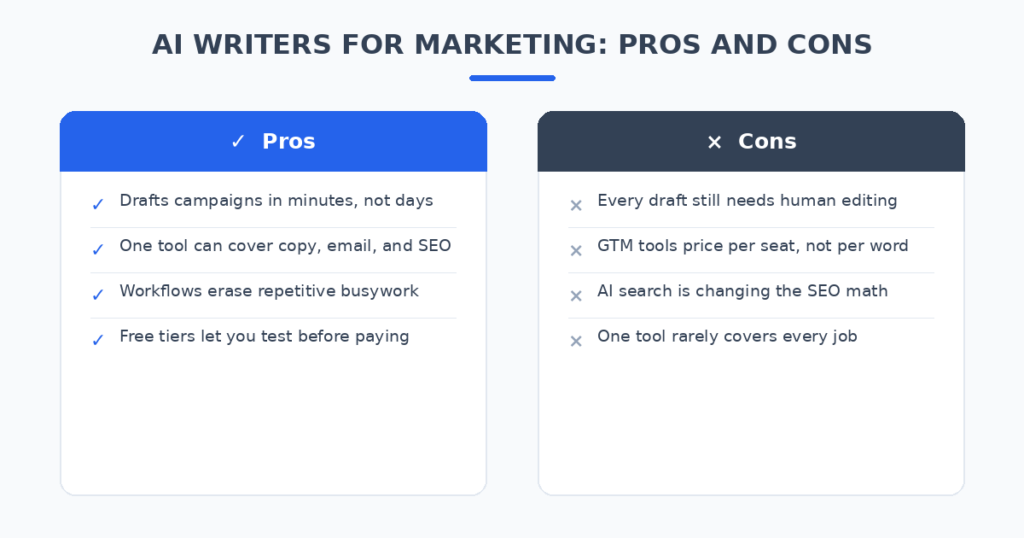
| Pros | Cons |
|---|---|
| Best-in-class workflow automation | Per-seat pricing adds up for teams |
| Excellent ad copy and cold outreach | Weaker at long-form SEO content |
| Deep CRM and sales-stack integrations | Free tier is small (~2,000 words) |
| Multi-step workflows replace busywork | No GEO or AI-search visibility tools |
Best for: Marketing teams that support sales — outbound, paid ads, email campaigns, and social distribution.
Writesonic — the SEO content engine
Writesonic went the opposite direction: it’s built to rank content. Article Writer 6.0 produces genuinely structured long-form drafts — proper headings, intros that aren’t filler, sections that stay on topic. It pulls real-time web data while writing, which cut the hallucination problem noticeably in my tests, and the built-in SEO tools (native Surfer-style scoring plus a GEO suite that tracks brand mentions in ChatGPT, Perplexity, and AI Overviews) are things Copy.ai simply doesn’t offer.
The tradeoff is automation depth. Writesonic has 100+ templates and Chatsonic for conversational work, but there’s no equivalent of Copy.ai’s Workflow builder — you’re generating one asset at a time rather than automating a pipeline. The team features are also lighter, which shows once more than two or three people share an account.
Pricing: Free plan with 10,000 words/month; Individual plan from around $16/month (annual billing) with high word limits; team plans around $79/month.
| Pros | Cons |
|---|---|
| Strong long-form SEO article quality | Lighter team collaboration features |
| GEO tracking for AI search visibility | No multi-step workflow automation |
| Generous free tier (10k words) | Brand voice weaker than premium rivals |
| Cheapest path to unlimited-ish output | Output still needs fact-checking |
Best for: Content and SEO teams producing blog posts, landing pages, and articles that need to rank — and be cited by AI search.
Which wins for what
| Job | Winner | Why |
|---|---|---|
| Cold outreach & sales emails | Copy.ai | Workflows personalize at scale; best cold drafts in testing |
| Paid ad copy variants | Copy.ai | Short-form conversion copy is its home turf |
| SEO blog articles | Writesonic | Article Writer 6.0 + native SEO scoring |
| AI search visibility (GEO) | Writesonic | Only one of the two with GEO tracking |
| Marketing automation | Copy.ai | Multi-step Workflows; 2,000+ integrations |
| Budget / free testing | Writesonic | 10k free words vs ~2k; cheaper entry paid plan |
| Team collaboration | Copy.ai | Multi-seat workflows beat lighter sharing features |
How to pick the right one for your team
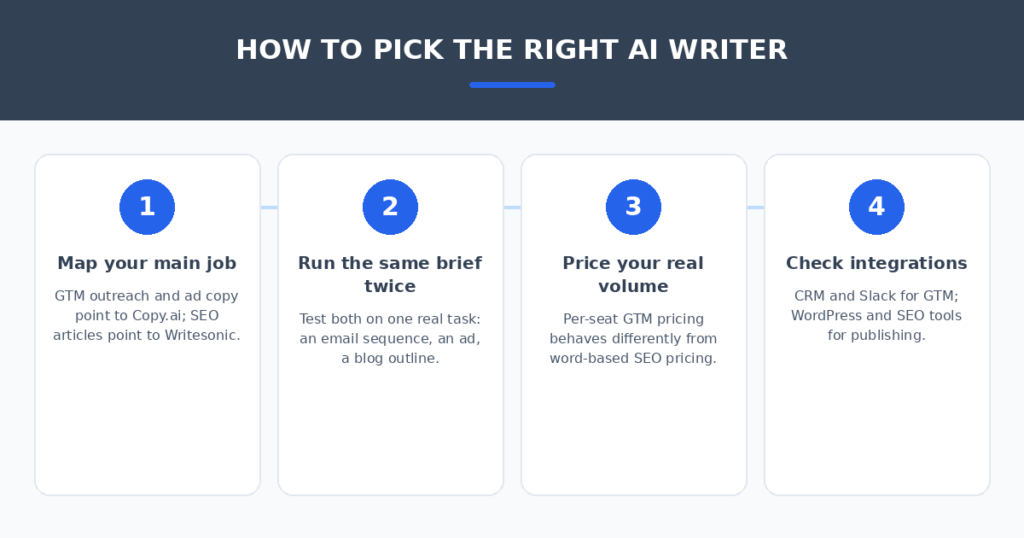
Forget the feature lists. Answer these four questions and the choice makes itself:
- What does your team produce weekly? If the answer is campaigns, ads, and sales support — Copy.ai. If it’s blog posts and landing pages — Writesonic. Your main output decides.
- Run the same brief in both. One real task — an email sequence, an ad, a blog outline — tells you more than any review. Both have free tiers, so this test costs you an hour.
- Price your real volume. Copy.ai charges per seat; Writesonic charges by words. A 5-person team on per-seat pricing can cost 2–3x a word-based plan — do the math on your headcount.
- Check the integrations you already pay for. HubSpot or Salesforce in the stack favors Copy.ai; a WordPress publishing flow favors Writesonic.
If your team also handles live customer questions on your website, a chatbot can cover that while the writers write — I compared AI chatbots for small business websites that answer FAQs while you sleep. And if freelancers on your team send client proposals, these AI proposal generators for freelancers turn briefs into polished proposals fast.
FAQ
Can one tool replace the other?
Not really — that’s the honest answer. Copy.ai can’t match Writesonic’s SEO article depth or GEO tracking, and Writesonic can’t match Copy.ai’s workflow automation. Teams that do both jobs often end up with both tools, using each for what it does best.
Which is cheaper for a small marketing team?
Writesonic, usually by a wide margin. Its free tier is 5x larger (10k vs ~2k words) and solo paid plans start around $16/month. Copy.ai’s per-seat pricing (~$24–36/month per seat) adds up fast — a 4-person team can cost $100+/month before you write a word.
Do these tools work with my CRM?
Copy.ai integrates with HubSpot, Salesforce, and Slack plus 2,000+ apps via Zapier — it’s the stronger pick for sales-stack integration. Writesonic connects to WordPress, SurferSEO, and Ahrefs, which suits publishing workflows better.
Which produces better long-form content?
Writesonic, clearly. Article Writer 6.0 with real-time web research produces structured, on-topic long-form drafts. Copy.ai’s strength is short-form conversion copy — its long-form output needs significantly more editing.
What about AI search (GEO)?
This is Writesonic’s unique edge: it explicitly tracks how your brand appears in ChatGPT, Perplexity, and Google AI Overviews. If being cited by AI search matters to your 2026 strategy, Copy.ai offers no equivalent.
My verdict
The honest verdict: pick the tool that matches your team’s main job. If your marketers support sales — outbound sequences, ad campaigns, email nurtures — Copy.ai’s workflows will save more hours than any article generator could. If your team lives and dies by organic traffic, Writesonic’s Article Writer 6.0 plus GEO tracking is the better investment, at a lower price.
The wrong pick here is expensive. A GTM team on Writesonic will drown in one-off generations; an SEO team on Copy.ai will pay per-seat prices for thin articles. Run the same brief in both free tiers this week — your team’s actual output will tell you which one to buy.
Related reading
Sources: Copy.ai