

Last spring I helped a friend who runs a 12-person plumbing supply company hire an office manager. The job post went live on a Monday morning. By Friday, 214 applications had landed in her inbox — the kind of avalanche AI resume screening tools for small businesses are built to sort.
She has no HR department. She spent two full evenings clicking through PDFs, most of them from people who clearly hadn’t read the posting. By application 90, she admitted she was skimming so fast she probably missed good candidates.
That is the exact problem AI resume screening tools claim to solve: read every resume, rank them against what you actually need, and hand you a shortlist worth your time. I spent three weeks testing five tools built for (or at least priced for) small businesses, running the same batch of 30 anonymized resumes through each one. Here is what I learned.
What an AI Resume Screening Tool Actually Does
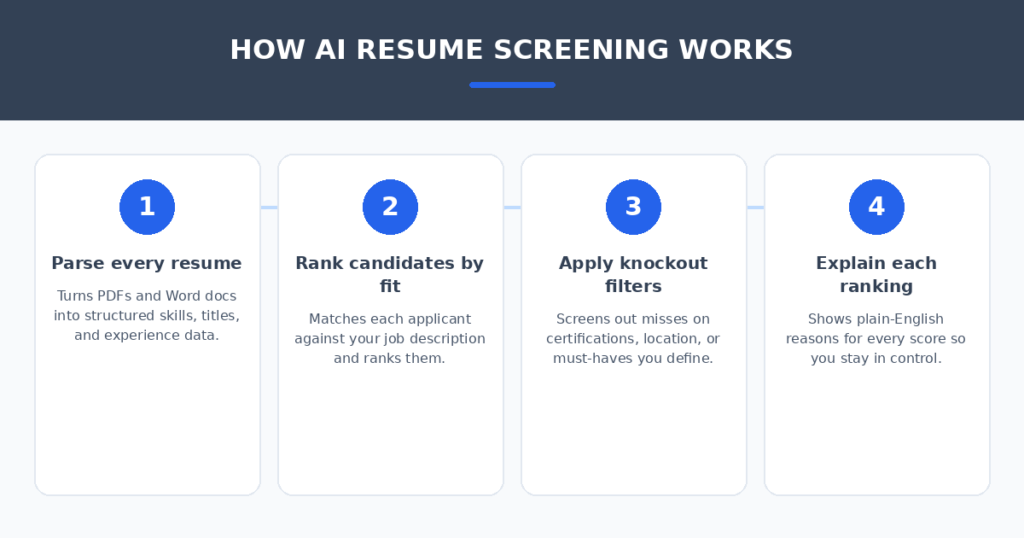
Strip away the marketing and these tools do four things:
- Parse resumes from PDF, Word, and email into structured data (skills, job titles, years of experience, education).
- Match each candidate against your job description and rank them by fit.
- Filter using knockout criteria you define, like required certifications or location.
- Summarize why each candidate ranked where they did, so you are not staring at a black box.
What they do not do: interview anyone, check references, or make the final call. The good ones are very upfront about this. The tool narrows the pile; you still pick the person.
How I Tested These Tools
I signed up for free trials or free tiers of each tool using a test company profile. My evaluation criteria:
- Setup time — could I go from signup to screening resumes in under an hour?
- Ranking accuracy — I ran 30 real, anonymized resumes (a mix of strong, average, and clearly unqualified) through each tool for the same fictional office-manager role, then compared the tool’s top 10 against my own manual ranking.
- Small-business pricing — is there a usable free tier or a plan under roughly $100/month?
- Job board integration — does it pull applicants from Indeed, LinkedIn, or a careers page automatically?
- Control and transparency — can I see why a candidate was ranked, and can I override it?
The 5 Tools Worth Your Time
1. Breezy HR
Breezy is the tool I would hand to a first-time hiring manager. Signup took about ten minutes, and its AI screening sits inside a clean pipeline view: applied, screened, interview, offer. You write the job description, and Breezy suggests screening criteria based on it.
In my test it correctly placed 8 of my manual top 10 in its own top 10. The two it missed were career-changers with unusual job titles — a known weak spot for every tool I tested, not just Breezy. What I liked most is the candidate scorecard: each applicant gets a plain-English explanation of their score, which makes it easy to sanity-check the AI’s judgment.
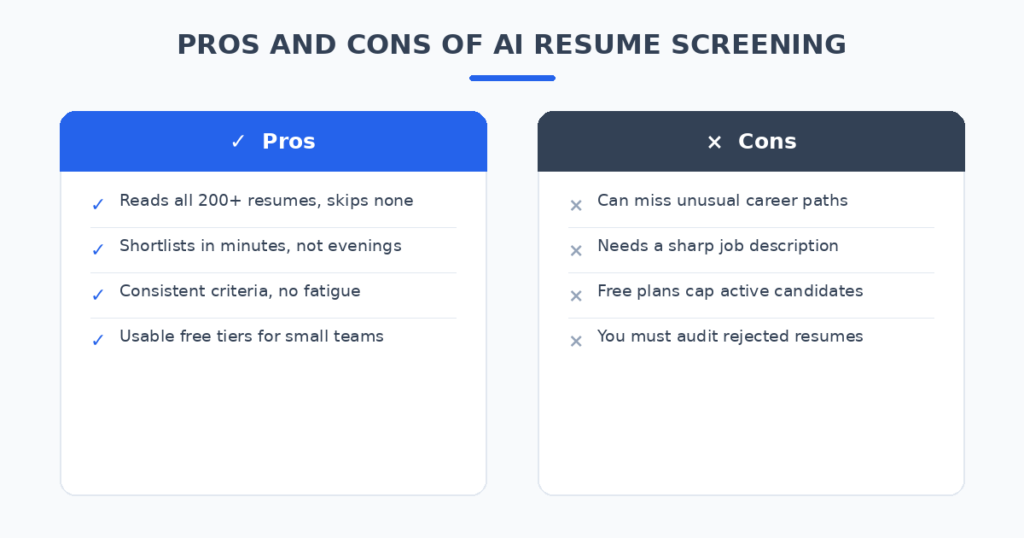
- Pros: Fastest setup of the bunch; clear explanations for every score; good free tier for a single active job.
- Cons: The free plan caps active candidates; advanced reporting needs a paid tier.
- [EDITOR’S NOTE — INSERT REAL SCREENSHOT HERE: Breezy HR dashboard showing the AI-ranked candidate pipeline]
2. Workable
Workable is the most established name here and it shows in the polish. Its AI screening reads the job description and auto-suggests must-have versus nice-to-have requirements, which is genuinely useful if you have never written screening criteria before. It also has the widest job-board distribution of the tools I tested — post once, and the listing goes out to dozens of boards.
Accuracy was strong: 9 of my top 10 matched. It handled the career-changers slightly better than Breezy, pulling in one candidate whose title didn’t match but whose skills clearly did. The tradeoff is price — there is a free trial but no permanent free tier, and plans are per-seat.
- Pros: Best job-board reach; nuanced matching that looks past job titles; solid mobile app for reviewing on the go.
- Cons: No free tier; overkill if you hire once a year.
3. Zoho Recruit
If your business already lives in Zoho’s ecosystem (Zoho Books, Zoho CRM), this is the obvious pick. The AI screening is competent — 7 of my top 10 matched — and the real draw is that candidate data flows straight into the rest of your Zoho setup. Hired someone? Their record is already in your system.
On its own merits it is a little less slick than Breezy or Workable, and the interface takes a day to get comfortable with. But the free tier is generous, and the paid plans are among the cheapest here.
- Pros: Generous free tier; deep integration with Zoho’s other business apps; low prices.
- Cons: Dated interface; screening explanations less detailed than Breezy’s.
4. Manatal
Manatal’s pitch is AI enrichment: it doesn’t just screen the resume you received, it pulls in publicly available professional data to build a fuller candidate profile. In practice this meant richer profiles and slightly better ranking of candidates with thin resumes — it placed 8 of my top 10 correctly.
The interface is modern and the per-seat pricing is friendly to small teams. My reservation is the enrichment itself: it is only as good as the candidate’s public footprint, so it adds less value for hourly or entry-level roles where applicants may not have detailed LinkedIn profiles.
- Pros: Candidate enrichment adds useful context; modern interface; fair pricing.
- Cons: Enrichment less useful for entry-level or hourly hiring; smaller integration library than Workable.
5. Freshteam by Freshworks
Freshteam is the HR-suite option: screening is one module inside a broader system that also handles onboarding, time off, and employee records. The AI screening itself is straightforward — it scored 7 of my top 10 — but the appeal is consolidation. If you are tired of juggling five separate HR tools, doing hiring and onboarding in one place has real value.
The free tier covers up to 50 employees, which is generous for a genuinely small business. Screening customization is a bit shallower than the specialists, though.
- Pros: Free for up to 50 employees; combines hiring with onboarding and HR records; simple to learn.
- Cons: Screening features less deep than Breezy or Workable; best if you want the whole suite.
AI Resume Screening Tools for Small Businesses: Side-by-Side Comparison
| Tool | Best for | Free option | Paid plans start around | Standout feature |
|---|---|---|---|---|
| Breezy HR | First-time hiring managers | Yes, 1 active job | ~$120/mo | Plain-English score explanations |
| Workable | Maximum applicant reach | Trial only | ~$150/mo | Auto-suggested screening criteria |
| Zoho Recruit | Zoho ecosystem users | Yes, generous | ~$30/mo | Built-in CRM/HR integration |
| Manatal | Roles needing deep profiles | Trial only | ~$15/seat/mo | AI candidate enrichment |
| Freshteam | All-in-one HR on a budget | Yes, up to 50 employees | ~$70/mo | Hiring + onboarding in one place |
(Pricing changes often — treat these as ballparks and check current plans before deciding.)
How to Get Genuinely Good Results
The tool matters less than the setup. Four things made the biggest difference in my tests:
- Write a specific job description. Vague postings (“rockstar wanted!”) produce vague rankings. List the actual tasks and the 3–4 skills that matter most. Every tool I tested ranked better with a concrete job description.
- Use knockout questions. Most of these tools let you add screening questions to the application (“Do you have a valid driver’s license?”). Two or three well-chosen questions filtered out more noise than any AI ranking.
- Always review the “maybe” pile. I found two strong candidates sitting at ranks 14 and 17 in one test. Skim the middle of the list, not just the top 10.
- Keep a human making the final call. Use the ranking to decide who gets a phone screen, not who gets hired. Every vendor I spoke with says the same thing, and they’re right.
Three Mistakes I See Small Businesses Make
Screening for keywords instead of skills. If your job needs “Excel,” don’t reject someone whose resume says “spreadsheets and data analysis.” Write criteria around capabilities, and check how the tool handles synonyms before you trust it.
Setting filters too tight. Requiring “5+ years” when 3 would do can wipe out half your pipeline. Start loose, look at who comes through, then tighten.
Never auditing what the AI rejected. Once a month, spot-check 20 rejected resumes. It takes 30 minutes and it is the only way to know if your filters are working or quietly discarding good people.
One more note: hiring touches employment regulations that vary by location. These tools help you organize and rank applicants — they don’t replace a basic understanding of fair hiring practices in your area. When in doubt, a quick consult with an HR professional is money well spent. (This is practical caution, not legal advice.)
FAQ
Do AI screening tools replace recruiters?
For a small business that doesn’t have a recruiter, they replace the worst part of recruiting: the initial resume slog. They don’t replace judgment. Think of them as a very fast first reader, not a decision-maker.
Will this work for hourly or shift-based roles?
Yes, with simpler criteria. For hourly roles I found knockout questions (availability, location, certifications) did most of the heavy lifting, with AI ranking as a useful second pass. Manatal’s enrichment adds the least here; Breezy or Freshteam fit better.
How many applicants make it worth it?
My rule of thumb: if a posting regularly draws 40+ applications, screening software pays for itself in an afternoon. Below that, you can honestly just read them all.
Do these integrate with Indeed and LinkedIn?
Workable and Breezy have the broadest distribution and integrations. Zoho Recruit and Freshteam cover the major boards too. If most of your applicants come from one specific board, confirm the integration exists before you commit — don’t assume.
Can candidates tell they’re being screened by AI?
They’ll notice the structured application and possibly an automated acknowledgment email. In my experience candidates care far more about getting a timely response than about how the first sort happened. Most of these tools can send automatic status updates, which candidates actually prefer over silence.
My Verdict
If you are hiring for the first time or hire a few times a year, start with Breezy HR’s free tier. It is the fastest to set up, its score explanations keep you in control, and you can learn what good screening criteria look like before spending anything.
If you hire constantly and want maximum reach, Workable earns its price. If you already run on Zoho, Zoho Recruit is the no-brainer. And if you want hiring folded into a broader HR system for free, Freshteam is hard to argue with.
Whatever you pick, remember the tool is the assistant, not the hiring manager. Write a sharp job description, add knockout questions, skim the middle of the pile, and make the final call yourself. Do that, and you will get through 200 resumes in an evening instead of a week.
Hiring is only the first step — once your new team member (or contractor) starts, you’ll want your admin to run itself too. I tested AI invoice generators for freelancers that turn a sentence into a billable invoice, and if you take phone inquiries, AI chatbots for small business websites can handle the repetitive questions so your new hire can focus on real work.
Related reading
Sources: Indeed